Causes
Alopecia areata
Round patches, not a receding hairline. A dermatologist’s condition, with one NHS tablet decision for severe disease.
Written in the UK, for women and men.
Alopecia areata is a non-scarring, usually relapsing hair loss thought to be autoimmune. It causes smooth patches and can, rarely, affect all scalp or body hair. There is no cure. Mild disease may regrow without treatment. NICE recommends ritlecitinib for severe alopecia areata from age 12 when the company supplies it under a commercial arrangement. Baricitinib is not recommended for routine NHS use.
See a GP if hair loss is sudden, patchy, or comes with illness, a rash, or other symptoms. The NHS asks for that conversation before a private clinic.
On this page
On this page
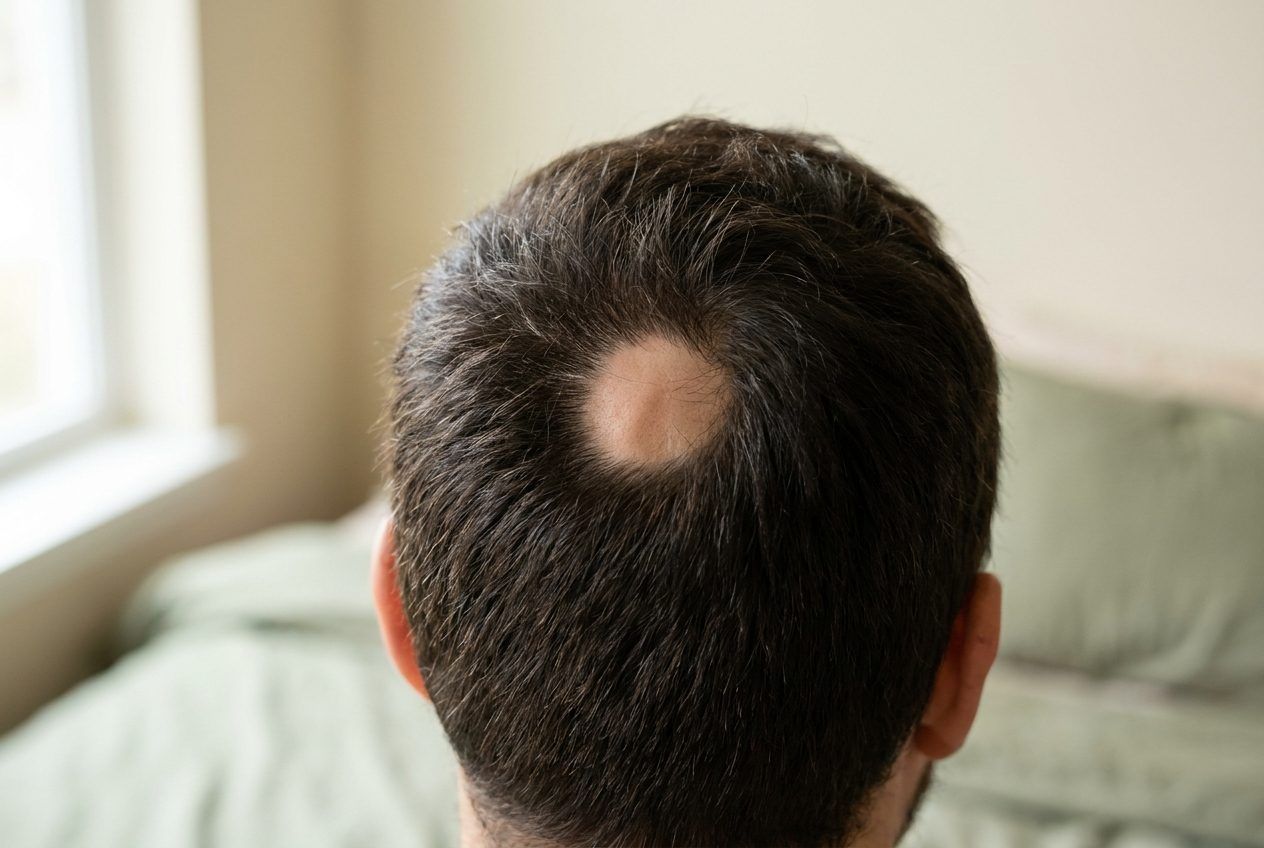
Alopecia areata is not pattern baldness. NICE CKS describes a chronic inflammatory condition that usually relapses, does not scar, and is thought to be autoimmune. It can start at any age. Men and women are affected equally, often first in the second or third decades. A clinician makes the diagnosis by looking.
What can it do?
The British Association of Dermatologists describes coin-sized patches of hair loss. Hair can all leave the scalp (alopecia totalis) or the body (alopecia universalis). Nails can be involved. It is linked with other autoimmune conditions, including vitiligo, type 1 diabetes and atopy. There is no cure. Mild disease may regrow with no treatment. That is not a percentage.
The NHS hair-loss page lists treatments used for patchy loss in general: steroid injections, steroid creams, immunotherapy, and light treatment. Not all of them are available on the NHS. A dermatologist chooses, not a shop.
What has NICE said about tablets?
Ritlecitinib (Litfulo) is recommended for severe alopecia areata in people aged 12 and over, and only if the company provides it under the commercial arrangement. NICE describes it as the first NHS treatment of this type licensed for severe disease.
Baricitinib (Olumiant) is not recommended for routine NHS commissioning for severe alopecia areata in adults. It has a licence, and people already taking it may continue until they and their doctor decide to stop. The plain-English version is ritlecitinib on the NHS.
What does not belong here?
Minoxidil and finasteride are pattern-loss drugs. A hair transplant is not usually suitable for alopecia areata, which is what the NHS transplant page says. Red light hats are not a treatment for this condition.
Alopecia UK is the patient organisation the dermatologists’ telogen leaflet also points to. Use it for support. Use a GP or dermatologist for the diagnosis.
Common questions
What does alopecia areata look like?
The British Association of Dermatologists describes smooth, coin-sized patches. It can become total loss of scalp hair or of all body hair. Nails can be affected.
Is there a cure?
No. The patient leaflet says there is no cure. Some mild disease regrows without treatment. The leaflet does not give a regrowth percentage as a promise.
What NHS treatment exists for severe alopecia areata?
NICE TA958 recommends ritlecitinib for severe alopecia areata in people aged 12 and over, only if the company provides it according to the commercial arrangement. TA926 does not recommend baricitinib for routine NHS commissioning.
Sources
Keep reading
-

-

-
-

-