Causes
Hair loss in women: the causes
A wider parting is the usual pattern. A shed, a patch, or tiredness can be something else, and a GP can tell.
Written in the UK, for women and men.
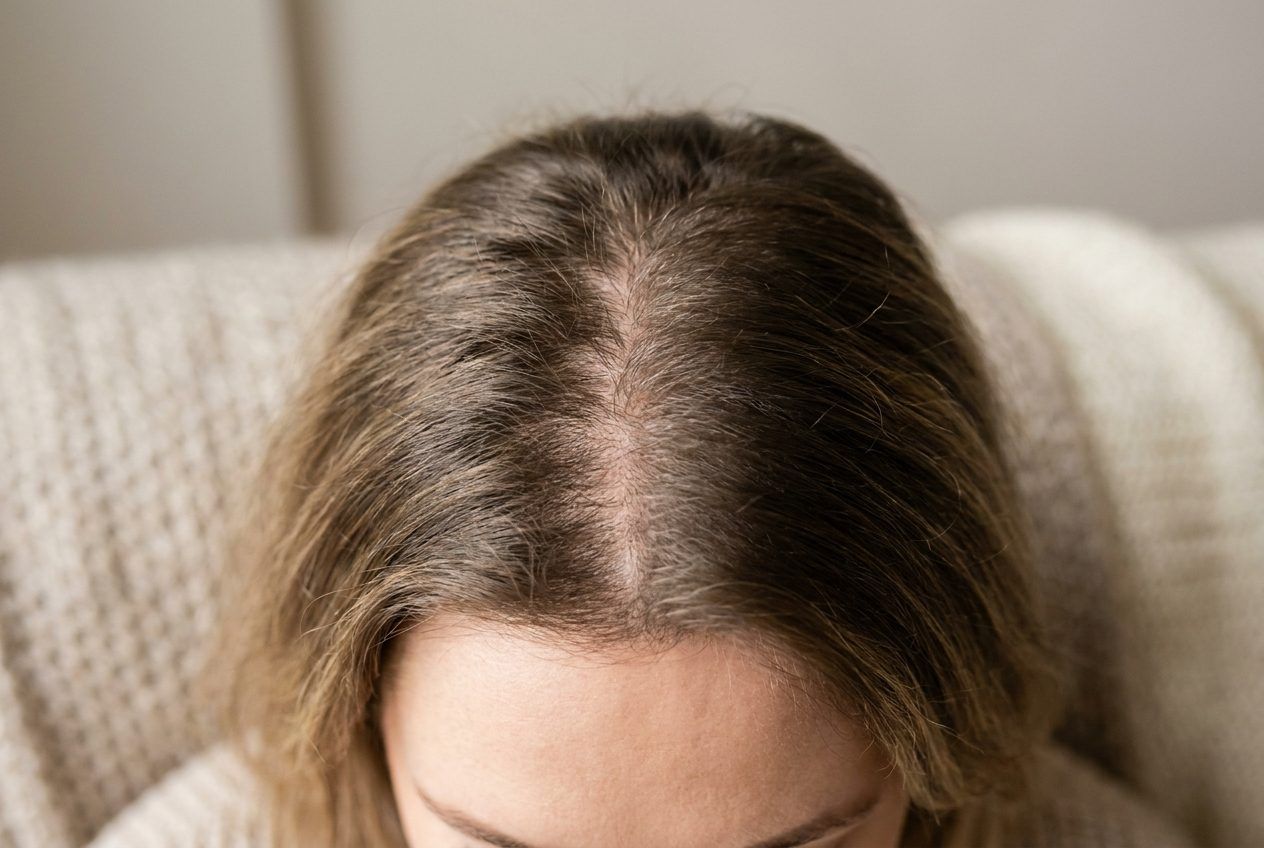
The common patterned loss in women is female pattern hair loss: thinner hair over the crown and front, a wider parting, and a frontal hairline that usually stays. Other causes include telogen effluvium, iron deficiency, thyroid disease, PCOS and alopecia areata. The NHS says women should not use finasteride.
See a GP if hair loss is sudden, patchy, or comes with illness, a rash, or other symptoms. The NHS asks for that conversation before a private clinic.
On this page
On this page
“Hair loss in women” is a pile of different problems. The one that looks like a family pattern has a name. The one that arrives after a fever has another.
What is female pattern hair loss?
NICE CKS, revised in this form through 2026, describes a diffuse reduction in hair density over the crown and frontal scalp, widening of the central parting, and a frontal hairline that is retained. The role of androgens is less clear than in men, which is why “female pattern hair loss” is the preferred name, not a copy of the male diagnosis.
The NHS says this kind of loss is often permanent, that it usually runs in the family, and that minoxidil can be used. Women should not use finasteride. Treatment does not work for everyone and only works while it is used.
What else looks like it?
| Clue | Read next |
|---|---|
| Handfuls of hair after illness, stress or weight loss | Telogen effluvium |
| Months after giving birth | Postpartum shedding |
| Periods changing, age often 45 to 55 | Menopause, which can overlap with pattern loss |
| Tiredness, paler skin, heavy periods | Iron deficiency anaemia |
| Tiredness, feeling cold, dry hair | Underactive thyroid |
| Irregular periods and scalp hair loss | PCOS (polycystic ovary syndrome) |
| Smooth round patches | Alopecia areata |
| Tight styles over years | Traction |
Iron deficiency is worth taking seriously because the NHS lists hair loss among its less common symptoms, and heavy periods are a very common cause. An underactive thyroid includes dry hair or hair loss in the symptom list, and the treatment is levothyroxine, not a shampoo. PCOS (polycystic ovary syndrome) includes hair loss among its main symptoms.
None of those are diagnoses you make from a photograph. A GP can examine the scalp and order bloods. See them before a private clinic, which is the NHS advice for hair loss in general.
The women’s front door, with the pages in a shorter list, is women’s hair loss.
Common questions
What is the most common pattern in women?
Female pattern hair loss. NICE CKS describes a diffuse reduction over the crown and frontal scalp, widening of the central parting, and a retained frontal hairline.
Can low iron cause hair loss in women?
The NHS lists hair loss as a less common symptom of iron deficiency anaemia. Heavy periods and pregnancy are very common causes of that anaemia. A blood test decides it.
Which medicine can women use?
The NHS says minoxidil can treat female pattern baldness, and that women should not use finasteride.
Sources
Keep reading
-

-
-

-
-