
News
Is Gen Z going bald earlier?
The question assumes a trend. The studies measure something else: risk factors in young adults, and one country’s rise in a different kind of hair loss.
There is no good evidence that Generation Z is going bald earlier than previous generations. No UK study has measured that. A 2024 review of early-onset pattern loss describes risk factors such as family history, smoking, diet and body weight. It is not a generational comparison. The clearest recent rise in young men is an Israeli study of alopecia areata, which is a different disease.
See a GP or doctor if hair loss is sudden, patchy, or comes with illness, a rash, or other symptoms. The NHS asks for that conversation before a private clinic.
On this page
On this page
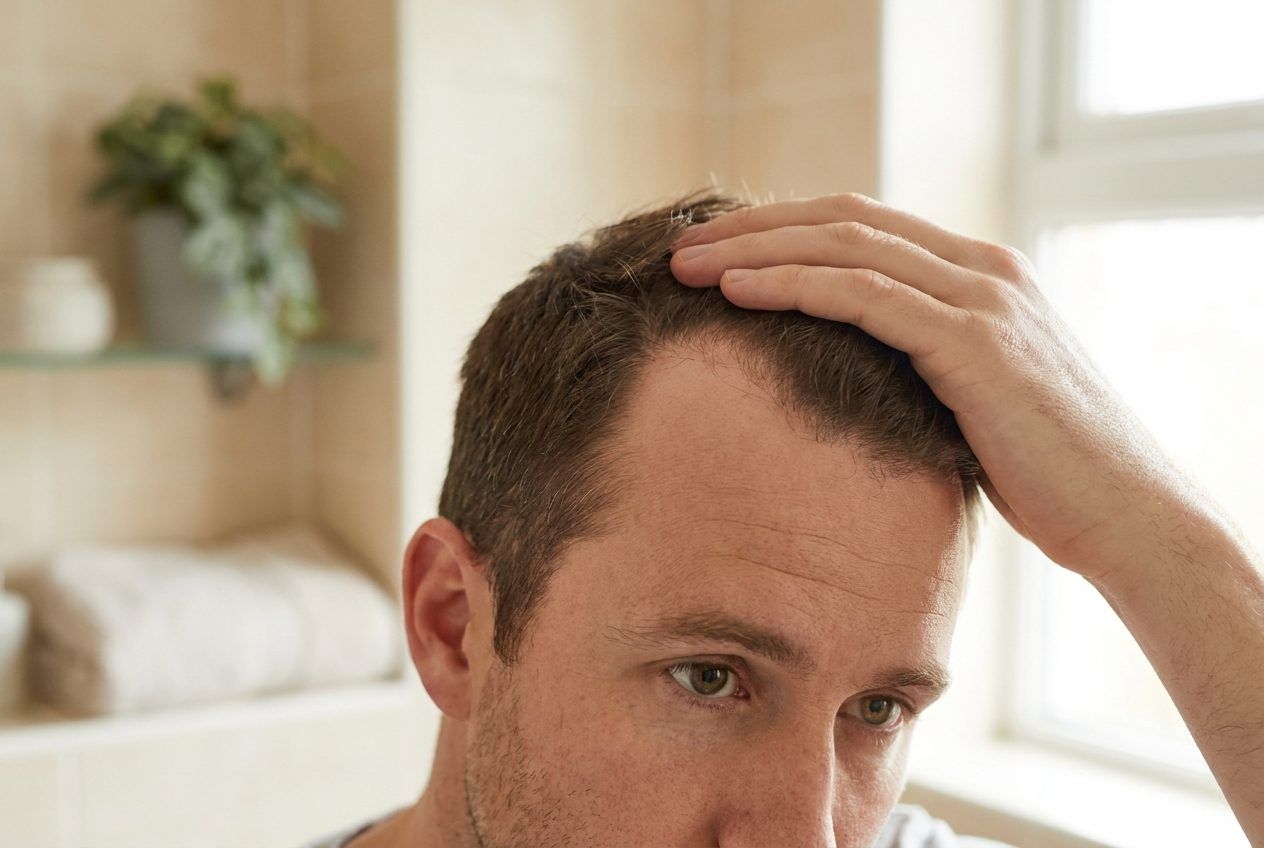
No. The claim that Generation Z is going bald earlier than their parents is not something a UK study has shown. Pattern hair loss in young adults is real, and it is not new. What has changed, on the evidence we can check, is how visible it is, not a measured national epidemic.
Written 18 October 2026. If a later UK cohort study appears, this page should change. It should not change because a brand blog listed six causes.
What people are pointing at
The search question, “why is Gen Z balding so fast?”, treats the trend as settled. The pages that rank for it are mostly product blogs and news interviews. They do not cite a British birth-cohort comparison of Hamilton–Norwood stages at age 25. This page does not invent that figure to fill the gap.
What the UK does have is an age curve, not a generation curve. NICE CKS says that, in general, 30% of white men have male pattern hair loss by age 30, 50% by 50, and 80% by 70, with the highest prevalence in Caucasians. Those percentages have been on the male pattern page because they describe age. A man of 28 who notices his temples is inside a figure that was already true of 30-year-olds. He is not, by himself, evidence that people born in 2000 are different from people born in 1970.
Female pattern loss is a different pattern, usually a wider parting with the frontal hairline kept. It is not what the “Gen Z men” headlines are about. It is also not rare, and it is not a social-media invention. The women’s hub is the way in.
What the early-onset review actually measured
Liu and colleagues published a scoping review in PLOS One on 7 March 2024. They included 65 studies of early-onset androgenetic alopecia. This is not a trial of a generation. It is a map of what researchers have associated with pattern loss that starts young.
The definitions do not even agree. “Early-onset” meant onset before age 30 in 43.08% of the studies. Other papers used 35 or 40. The authors say there is no unified definition. Of the 65 papers, 67.69% were case-control studies and 78.46% enrolled only men. The Hamilton–Norwood scale was the severity tool in 69.23% of the male assessments.
Reported associations, which are not the same as proof that a habit caused the hair loss, included a family history of pattern loss, cigarette smoking, unhealthy diet and a higher body mass index. The review also discusses hormonal profiles, 5-alpha-reductase activity, androgen-receptor genes and other susceptibility loci, and conditions that have been studied alongside early pattern loss, including metabolic syndrome, cardiovascular disease, insulin resistance and abnormal lipids. Young men with pattern loss were also described as more likely to report anxiety and low self-esteem than men without it.
The introduction cites a range of early-onset prevalence, 19.2% to 57.6%, across the populations in the studies it points to. That range is not a UK statistic, and the studies did not use one definition or one age band. Quoting a single percentage for “British men under 30” from it would be false.
Family history is the association that matches the basic biology NICE already describes: a genetic sensitivity of some follicles to dihydrotestosterone. Smoking, diet and weight are the associations that lifestyle articles stretch into “the cause”. The review does not show that a generation’s diet created a new disease. It shows that researchers keep finding the same cluster of risks in people whose pattern loss started young.
The study that did find a rise, and what it was
The hard incidence trend that turns up in this search is not pattern baldness.
Wohl and colleagues, in the Journal of Dermatology, used records from a large Israeli healthcare organisation from 2005 to 2019. They identified 30,805 people with alopecia areata across 29,504,798 person-years. The overall incidence was 104.4 per 100,000 person-years. Women had a lower rate than men (incidence rate ratio 0.72, 95% confidence interval 0.71 to 0.74). Across the whole cohort, the yearly incidence stayed stable.
Men aged 18 to 30 did not stay stable. Their incidence rose from 119.54 to 162.36 per 100,000 person-years over the study years. The authors call young male adults the group that emerged as highest risk, and they note they could not split the results by how severe the disease was. They speculate about stressors. Speculation is labelled as speculation in the paper, and it should stay that way here.
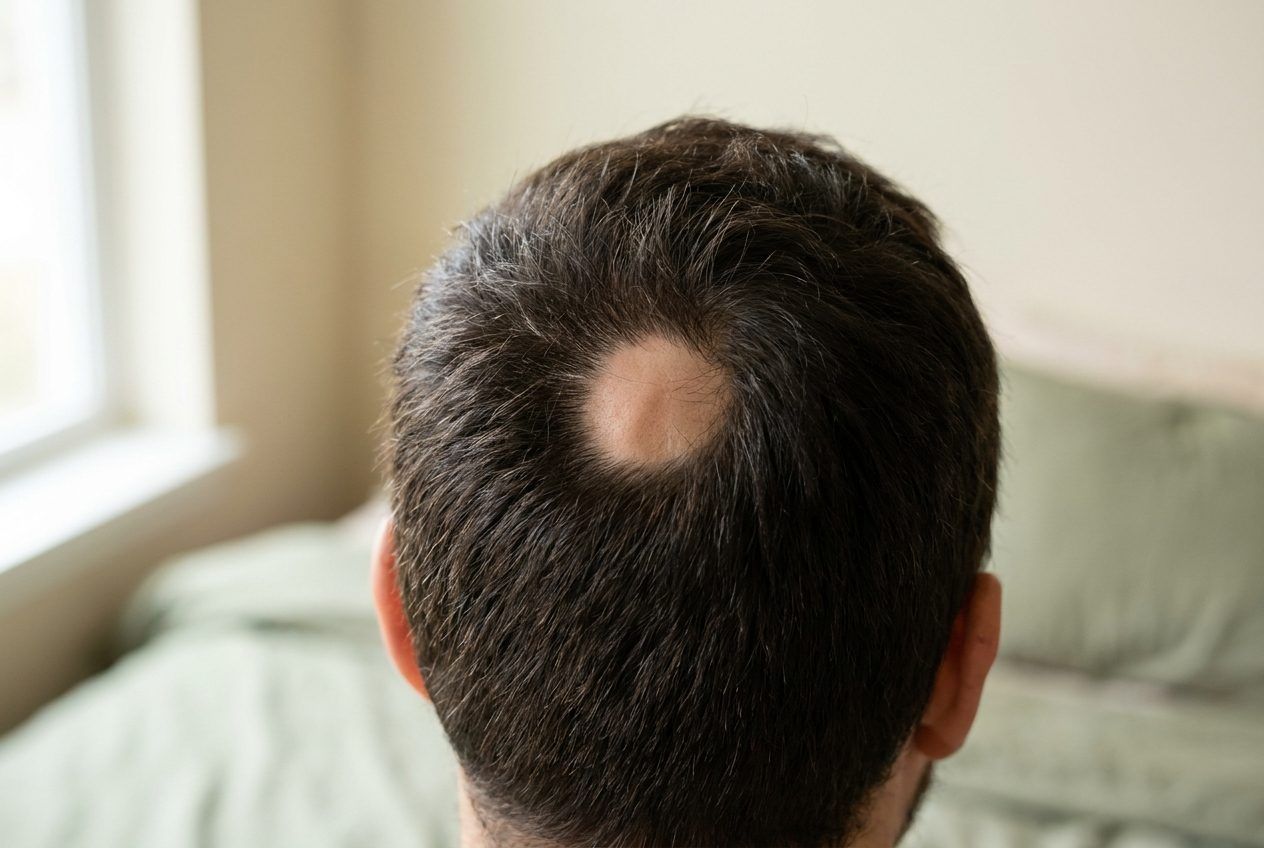
Alopecia areata is patchy loss. Smooth coins of scalp, sometimes eyebrows and lashes, sometimes the whole scalp. It is an immune condition. It is not the receding hairline of male pattern loss, and an Israeli time trend is not a British one. The NHS page and alopecia areata are the right next read if the loss is patchy. NICE has separate guidance for that disease, including specialist drugs for severe cases. None of that is a shampoo problem.
Why it feels as if everyone younger is thinning
A feeling can be real without a prevalence study behind it. More people photograph their hairline. More people start a pharmacy treatment in their twenties, so more people talk about it. Clinics advertise to that age group. None of those is a count of bald scalps, and this page will not invent a social-media percentage to decorate the point.
Pattern loss is also progressive. NICE describes it that way. Someone who would have waited until 40 to mention it may now mention it at 22, because the photographs exist and the products are on the high street. Earlier worry is not the same statistic as earlier baldness.
What would count as a real answer later
A useful study would take people born in a defined span of years, examine their scalps with the same scale, and compare them with people born earlier who were examined at the same ages. It would say which country, which ancestry, and whether the younger group was more likely to come forward because they were worried. Liu’s review is not that study. NICE’s age percentages are not that study. The Israeli alopecia areata curve is not that study.
Until a paper like that exists, the honest public sentence is the one at the top of this page. Early pattern loss happens. It has risk factors, chiefly a family history. It has not been shown, in the UK, to be a new generational event. Repeating the question in a headline does not create the missing cohort.
Clinics and brands gain from the shorter version, because a man of 23 who thinks he is early is a customer. That incentive is not evidence either. It is a reason to read the methods before the advert.
What a young adult can do without a prescription
See a GP if the loss is sudden, patchy, or comes with tiredness, weight change or a rash. The NHS asks for that conversation before a private clinic. A slowly receding hairline with relatives who look the same is the ordinary pattern, and NICE lists doing nothing as a legitimate choice.
If you want a pharmacy option, the licensed one is topical minoxidil, not a serum named after a generation. The ladder, including what is prescription-only, is treatments without a prescription. Finasteride is a prescription medicine for men. It is not a shopping choice, and this page does not name a brand or a clinic. Who to see, if you need a person rather than a bottle, is GP, trichologist or dermatologist.
Common questions
Is there a UK statistic for Gen Z baldness?
No. This page did not find a UK prevalence study that compares pattern hair loss in Generation Z with earlier generations. NICE’s figures, about 30% of white men by 30, 50% by 50 and 80% by 70, describe age, not a birth cohort.
What does early-onset pattern loss mean in the research?
There is no single definition. In Liu and colleagues’ 2024 scoping review, 43.08% of 65 studies used “before 30”. Others used 35 or 40. Most of the studies enrolled only men.
Did alopecia areata rise in young men?
In one Israeli healthcare system, from 2005 to 2019, the incidence of alopecia areata in males aged 18 to 30 rose from 119.54 to 162.36 per 100,000 person-years. The rate for the whole cohort stayed stable. Alopecia areata is patchy autoimmune loss, not the family pattern.
When should a young man see a GP?
If the loss is sudden, patchy, or comes with other symptoms, see a GP. A slowly receding hairline with a family history is the usual pattern, and doing nothing is a legitimate choice. Pharmacy options, if you want them, start with licensed minoxidil.
Sources
Keep reading
-

-
-
-

-